Val Thorens: High Altitude, Big Skiing and Proper Mountain Energy
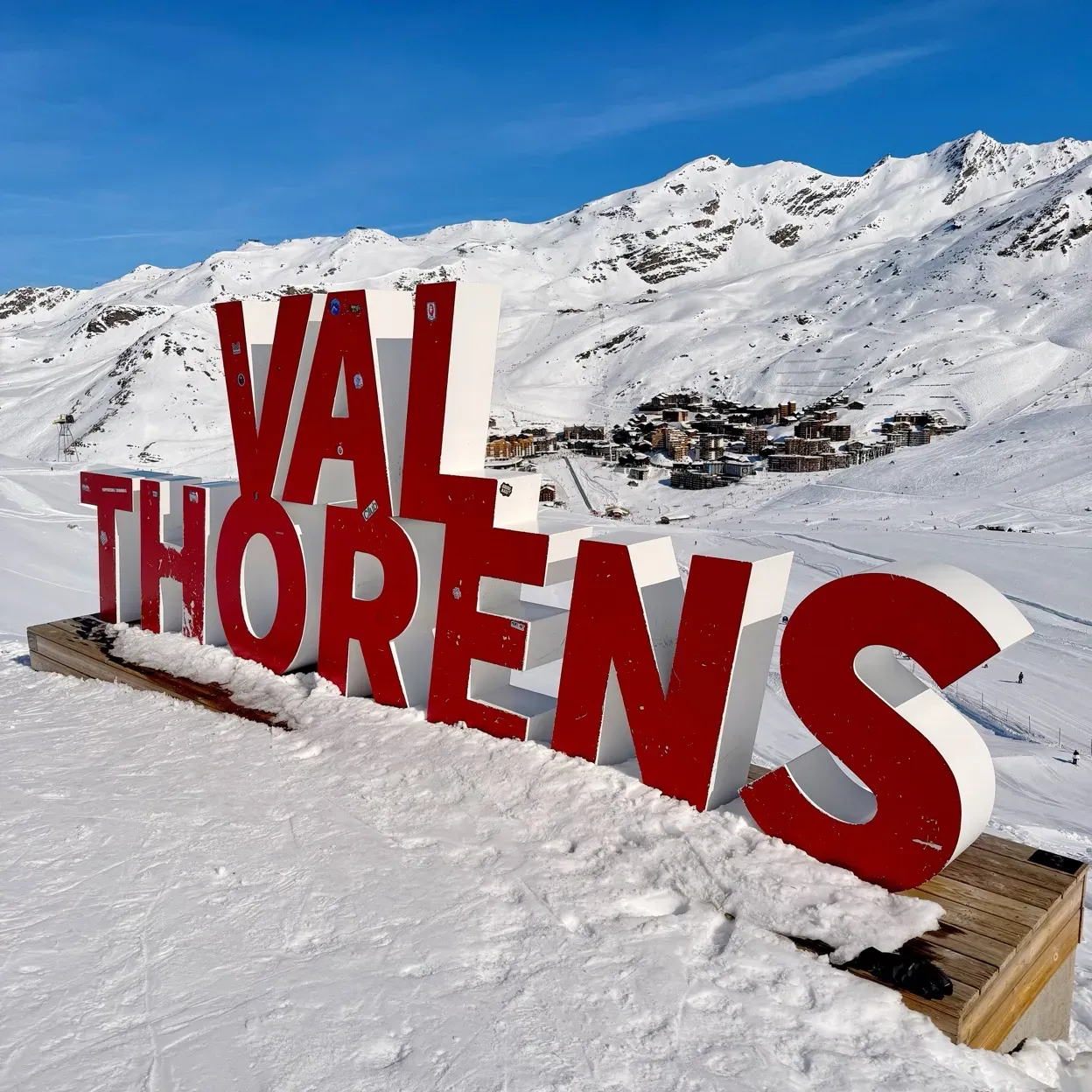
Val Thorens is one of the great names in European skiing. Sitting at the top of Les 3 Vallées, it is known as the highest ski resort in Europe and the highest point of the 3 Vallées ski area. The resort gives skiers and snowboarders direct access to the Val Thorens-Orelle area, with 150 km of slopes, and to the wider Les 3 Vallées ski area, with 600 km of skiing. The official resort also highlights that 99% of the domain sits above 2000 meters, which helps explain why Val Thorens has such a strong reputation for snow reliability.
That mix of altitude, scale and atmosphere is exactly why Val Thorens feels so at home in Ready Steady Slope. Our ski and snowboarding card game is built around the mountain moments that make a resort memorable: choosing your destination, building your mountain, collecting the right weather, finding your form and completing the runs that make the trip worthwhile.
Val Thorens delivers all of that in real life. Long cruising blues, steep black pistes, glacier views, modern lift links, late-season snow and a lively après-ski scene all combine into a resort with a very clear personality. Some ski areas feel scattered. Val Thorens feels concentrated, high and full of energy from first lift to last song.
A short history of Val Thorens
Val Thorens was born from a bold idea: build a high-altitude ski resort in an exceptional natural setting and connect it to one of the world’s most ambitious ski areas. The official history describes the resort as a project shaped by visionary pioneers, with its origins in the period from 1969 to 1971. Pierre Schnebelen, already involved in other integrated ski resort developments, helped drive the project at a time when large winter sports resorts were still controversial.
The early story gives Val Thorens much of its character. This was a challenging site, remote and exposed, but also full of potential. The resort developed through a mix of engineering, ambition and mountain stubbornness. In the 1980s, Val Thorens entered an era of innovation, including the construction of the Cime Caron cable car to reach 3,200 m. The official history describes that lift project as a major step that helped position Val Thorens among the leading winter sports resorts.
Today, Val Thorens has moved far beyond its pioneering years, but the original idea still shows through. It remains a high-altitude, ski-in and ski-out resort designed around easy access to the mountain. You can step out onto the snow quickly, move between sectors efficiently and build a ski day around sun, snow quality or the type of piste you want to chase.
Why Val Thorens works so well for skiers and snowboarders ⛷️🏂
Val Thorens has a rare advantage: altitude and variety in the same package. The resort sits in a vast natural cirque dominated by glaciers, with terrain that works for beginners, intermediates, advanced skiers and confident snowboarders. The official resort describes the area as offering everything from carving and groomed pistes to off-piste, ski touring, snowpark, boardercross and telemark.
For Ready Steady Slope players, that variety matters. A great mountain card needs more than one famous run. It needs different routes, different moods and different levels of risk. Val Thorens has mellow blues for cruising, famous reds for rhythm and distance, and serious black pistes where conditions and confidence matter.
The resort also rewards planning. You can head towards Cime Caron for height and views, Péclet for glacier scenery, Boismint for long sunny descents, Orelle for the feeling of slipping into the quieter “fourth valley”, or Plein Sud when you want skiing with a soundtrack drifting up from La Folie Douce.
La Folie Douce Val Thorens: après-ski at altitude
Val Thorens is famous for its skiing, but its après-ski scene is part of the resort’s identity too. La Folie Douce Val Thorens sits at 2,600 m and brings live music, DJs and terrace energy to the slopes. The venue describes its daily après-ski as a mix of electro, soul, funk, house, deep-house and rock, with live music and “intense party moments” facing the Alpine peaks.
This gives Val Thorens a distinctive end-of-day rhythm. You might start the morning on high, cold pistes under Cime Caron, spend the afternoon carving through Plein Sud, then finish with music in the mountain air before the final slide back into resort.
In Ready Steady Slope terms, La Folie Douce feels like the perfect place for a form boost, a lucky weather card or a special card that changes the whole mood of the round. It is part of what makes Val Thorens memorable beyond the lift map.
Famous pistes in Val Thorens
Combe de Caron, black piste ⚫️
Combe de Caron is one of the signature black runs of Val Thorens. Starting from the Cime Caron sector at around 3,200 m, it gives skiers one of the resort’s great panoramic moments before dropping into a serious descent. The official Val Thorens guide describes the summit as offering a 360 degree view over more than 1,000 peaks across the French, Swiss and Italian Alps.
The piste itself has real bite. It begins steeply, passes through a narrower section, then opens into wide valleys that demand both technique and stamina. Its north-facing orientation can help preserve good snow quality, which adds to its reputation as one of the great high-altitude tests in the 3 Vallées.
Combe de Caron is famous because it combines the things skiers remember: height, views, steepness, snow quality and a sense of occasion. You do not take the Cime Caron lift by accident. You go there because you want one of the resort’s big mountain moments.
Goitschel, black piste ⚫️
Goitschel is another Val Thorens black run with a strong personality. Located in the Plein Sud sector, it starts at around 2,900 m and is described by the resort as a steep, sustained slope that runs straight down the fall line. It is a piste that wakes up the legs quickly.
The setting adds to its appeal. Plein Sud is a sunny sector at the crossroads of the valleys, and the resort specifically links the end-of-day experience here with the atmosphere of La Folie Douce.
That makes Goitschel a brilliant Val Thorens run to feature in a game-inspired article. It has the challenge of a black piste, the altitude of a serious Alpine descent and the après-ski energy that gives the resort its social edge.
Christine, red piste 🔴
Christine is one of the most loved red pistes in Val Thorens. Found in the Péclet sector, it sits below the glacier and offers around 700 m of vertical drop. The official Val Thorens description calls it long, wide, undulating and full of changes in rhythm, with the west face of the Péclet glacier as a dramatic backdrop.
The name also has history. The piste is named after French ski champion Christine Goitschel, one of the great figures of French alpine skiing. That connection gives the run an extra layer of meaning, especially for skiers who enjoy pistes with a story behind them.
Christine is well loved because it offers challenge without feeling punishing. It is a proper red, but it also has flow. For confident intermediates, it is exactly the kind of piste that turns a good ski day into a great one.
Boismint and Plan de l’Eau, red pistes 🔴
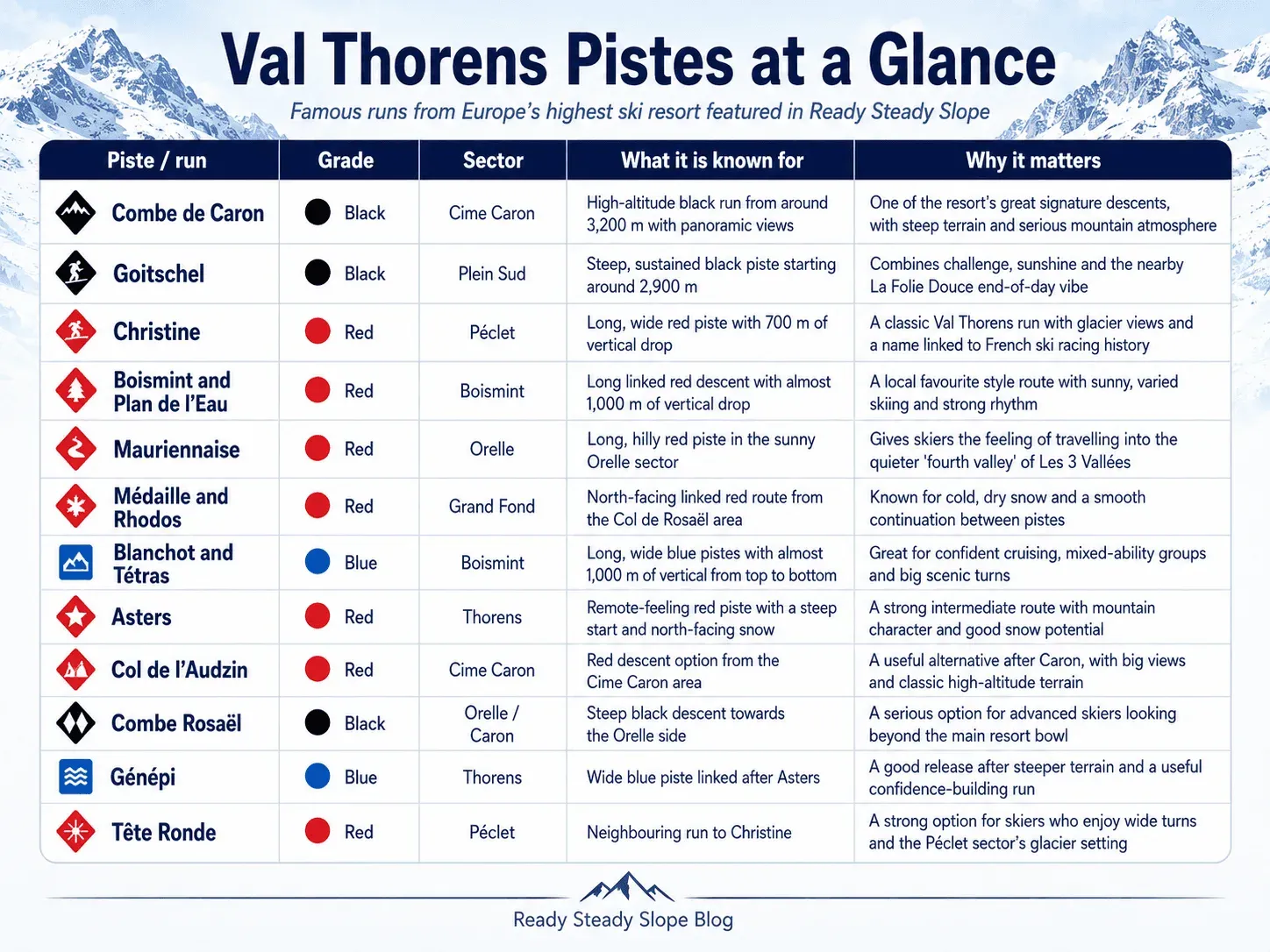
The linked descent through Boismint and Plan de l’Eau is one of the best long red options in Val Thorens. The resort highlights this route as a favourite of Timy Théaux, instructor and pro rider in Val Thorens. It runs from the top of the Boismint chairlift towards the bottom of the Plan de l’Eau chairlift, the lowest point in the area at 1,800 m. The two red pistes naturally follow each other and offer almost 1,000 m of vertical drop.
This route is famous in a quieter way than Combe de Caron. It is wide, varied and sunny, with a sustained feel that rewards skiers who like to settle into a rhythm. It can also be less obvious to visitors who stay around the central resort bowl, which gives it a slightly “local favourite” feel.
For Ready Steady Slope, this is the kind of descent that would make a great run card: long, satisfying and easy to underestimate until your thighs start to complain.
Mauriennaise, red piste 🔴
Mauriennaise sits on the Orelle side of the ski area, giving skiers access to the sunny, open terrain often described as the “fourth valley” of Les 3 Vallées. The official Val Thorens guide describes it as a long, red, hilly piste with semi-flat sections and a pleasant final wall.
Its appeal comes from the feeling of travelling across the mountain rather than simply skiing under the same lift. Orelle has a different atmosphere from the main Val Thorens bowl: more open, often sunnier, and with a sense of discovery for visitors who have only skied the central resort.
Mauriennaise is well loved because it gives strong intermediate skiers a proper journey. It is not just about difficulty. It is about distance, light, views and the feeling that you have reached another side of the mountain.
Médaille and Rhodos, red pistes 🔴
The linked Médaille and Rhodos route is another strong Val Thorens red option. The official guide places it in the Grand Fond sector, starting from the Col de Rosaël at around 3,000 m. Médaille is described as a north-facing red piste with cold, dry snow, followed naturally by Rhodos.
This is a good example of why Val Thorens has such a strong piste reputation. The altitude helps, but aspect matters too. North-facing slopes can hold snow well, giving the run a crisp, grippy feel when conditions line up.
For skiers who enjoy long, rolling reds, Médaille and Rhodos are worth building into the day. In game terms, this is a steady points-scoring route: dependable, scenic and satisfying.
Blanchot and Tétras, blue pistes 🔵
Val Thorens also has plenty for skiers and snowboarders who want long, confident cruising. The linked Blanchot and Tétras blue pistes in the Boismint sector are highlighted by the resort as long, wide and pleasant winding tracks. Together they offer almost 1,000 m of vertical drop from top to bottom.
These runs are loved because they show that Val Thorens is not only about expert terrain. A long blue descent with space to turn, changing scenery and a smooth gradient can be just as memorable as a black piste. For families, mixed-ability groups and improving skiers, these routes are valuable.
In Ready Steady Slope, Blanchot and Tétras would be the kind of runs that help you build momentum. They are approachable, scenic and ideal for players trying to complete a mountain without taking too many risks.
Asters, red piste 🔴
Asters sits in the Thorens sector and is described by the resort as a beautiful red piste in a remote valley. It begins quite steeply, then opens into two larger changes of gradient, with a strong north-facing aspect that can help preserve good snow. The run later joins the blue Génépi piste, which the resort notes for its width.
Asters is famous for its setting as much as its shape. It feels slightly removed from the busiest central slopes, giving the descent a more adventurous character. It has enough gradient to feel sporty, but enough variation to keep it enjoyable.
For confident intermediates, it is a strong choice when you want a run that feels more like a mountain line than a simple connector.
Why Val Thorens belongs in Ready Steady Slope
Val Thorens has all the ingredients of a great Ready Steady Slope resort: altitude, famous pistes, reliable snow, strong personality and a proper end-of-day story.
It gives players the feeling we want in the game. You choose the resort. You collect the right conditions. You build your mountain. You take on the runs. Sometimes you play it safe with a blue. Sometimes you chase points on a red. Sometimes you take a black piste and hope your form holds. In the game of Ready Steady Slope, each resort has four pistes. Val Thorens has 2 reds and 2 blacks. In real life there are many more blues. A small sacrifice to make the gameplay work. But if you are headed to the resort in search of blue runs, have no fear, there are plenty of gentler pistes to ride!
That is the real magic of Val Thorens. It works for different kinds of mountain people. Skiers who want long cruising blues can find them. Confident intermediates can spend days linking famous reds. Advanced skiers can test themselves on Combe de Caron, Goitschel or Combe Rosaël. Groups who love après-ski can finish the day with music at La Folie Douce.
For a resort that appears in a ski and snowboarding card game, Val Thorens makes complete sense. It is high, lively, varied and memorable. In other words, exactly the kind of place that turns a mountain trip into a story.
Final thoughts
Val Thorens has grown from a bold high-altitude project into one of the most recognisable ski resorts in Europe. Its history is rooted in ambition, its skiing is shaped by altitude and its atmosphere is powered by a mix of snow, sun, music and mountain scale.
From the views of Cime Caron to the rhythm of Christine, from the long blues of Boismint to the après-ski energy of La Folie Douce, Val Thorens is a resort full of playable moments. That made it one of our personal favourite resorts.
That is why it earns its place in Ready Steady Slope.
If you're planning a trip or just want to reminisce, go and checkout the resort from the webcams page. You'll find a link to all the in game resort webcams from there.
Some resorts give you a ski day. Val Thorens gives you a whole mountain round. 🎿🗻🏂